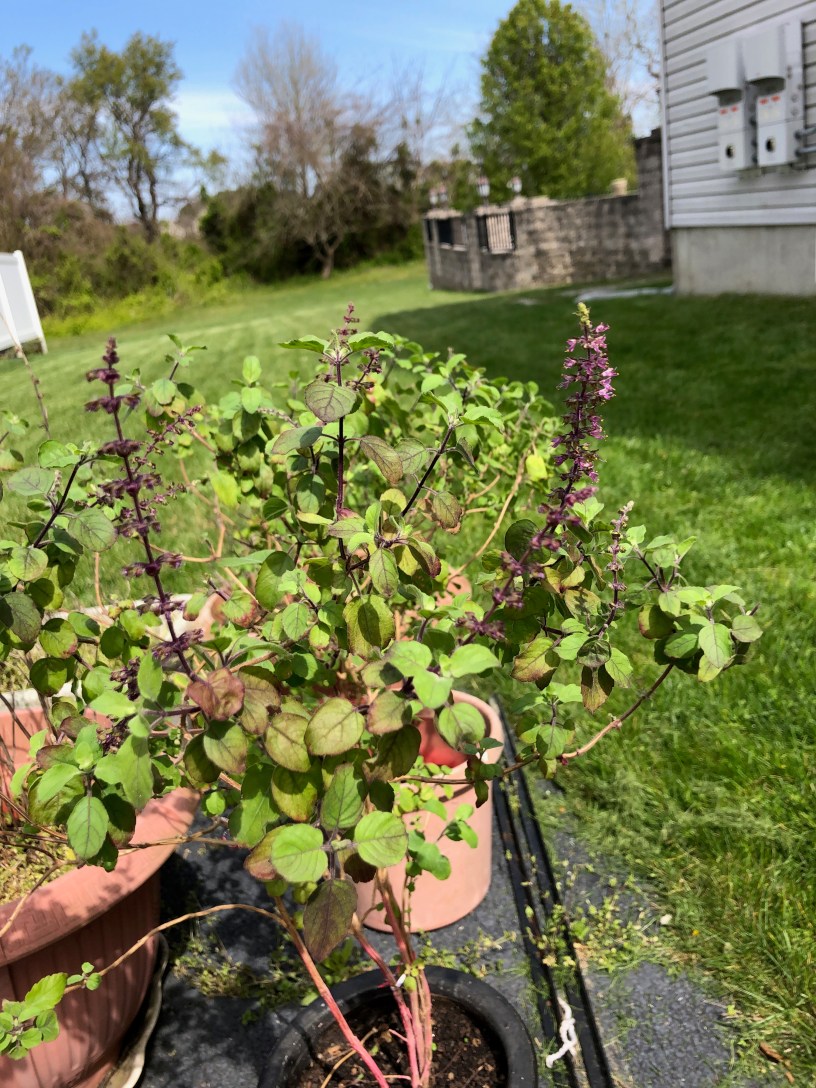
Ocimum tenuiflorum, commonly known as holy basil or tulsi
My mother likes to go on walks in my neighborhood with my sister and me after she returns from her job at the hospital in my town (she showers and changes her clothes beforehand). When on one of these walks, we saw a neighbor in their driveway, attending to some pots with plants in them. I remembered the english post I had to write, and asked to take a picture of one but asked them not to tell me which plant it was. I had no clue where to start to figure out what this plant was. It has a red, woody stem and purple flowers. Luckily, when I showed my mother the picture, she knew what it was, but only in Gujarati, which is my second language. I don’t know much, but I am able to have decent conversations with it. My mother only speaks to us in Gujarati, in order for us to practice it, but we reply in English, while my father’s main language is English so our conversations are only English. She called the plant Tulsi which she didn’t know in English.
So using that information, it was pretty easy to find the plant online. The Holy Basil plant is actually commonly known as Tulsi even in english. So by looking up just the word “Tulsi” I found the plant and it matched what I took a picture of.
I had my parents text that neighbor, asking what they used it for. They said they like to put it in their tea, because even though it is called “basil”, it has a minty flavor to it. I found it really cool to learn about an herb that I have never heard of.
-Romy Patel
 English 110 Honors Spring 2020
Very cool that you found out the name of a plant through your second language. I really like how you were able to use a different language to figure out the name of the holy basil. I’m happy that you were able to work with your neighbors even during this time of isolation. I’m not a big tea person myself, but I’m curious as to what it would taste like. Very nicely done!
-Austin Grimm
LikeLike
First off, it’s nice to read about the friendly relationship you have with your neighbors that is maintained even through these troubling times. Additionally, I found the way that you went about finding the plant’s name to be interesting. Finding a plant on the internet from a physical description alone can be very difficult (been there, done that) so it’s nice that your mom was able to point you in the right direction through your second language. I think speaking two languages at home is a very cool way to keep culture and tradition alive, and I had no idea you spoke a second language, so thanks for sharing that with us.
-Nick Whaley
LikeLike
I would first like to extend my gratitude to your mother for her hard work at your local hospital during this pandemic and at a time of such uncertainty.
Additionally, I think it is so cool that you’re exposed to more than one language at home and that it helped in your process of discovering this plant. I was initially drawn to your post because of the image of the tulsi plant. I knew it looked familiar because after lookin at it closer and reading your descriptions I remembered that growing up, my grandmother used to have this plant in her garden and she would take leaves from it all the time. She’d then let them sit on a towel to dry out and eventually use it for tea just as you explained. I can’t remember ever trying it, but now I wish I did…
Thanks for this unexpected opportunity to reconnect with an old memory! 🙂
-Bel Yu
LikeLike