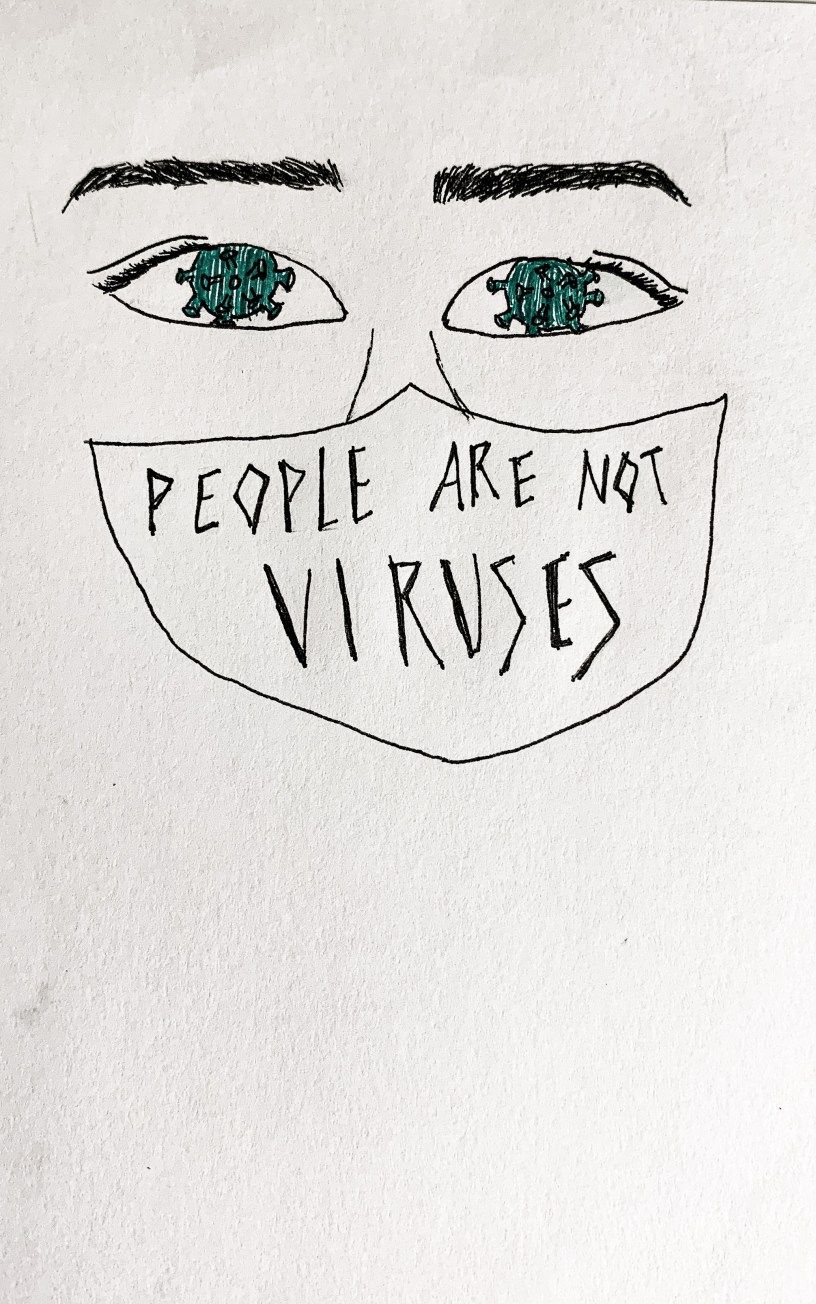
The first cases of SARS-CoV2 were reported in Wuhan, China. As the vast spread of SARS-CoV2, otherwise known as covid-19 or coronavirus, ultimately became stated as a global pandemic, racial slurs, aggression, and violence against those of Asian descent increased immensely. It is common to respond to an outbreak with fear, but this addition of fear in a global pandemic is a recipe for disaster. Under the presence of fear, anxiety, and ignorance, racism and xenophobia thrive. Our natural response to a problem is trying to find a source to blame it on. In this case, the blame went to China. “Following the spread of COVID-19 from Wuhan, China, discrimination towards Chinese people has increased. This includes individual acts of microaggression or violence, to collective forms, for example Chinese people being barred from establishments(Devakumar et al).”
About 100 years ago, a pandemic, similar to this one, affected populations worldwide. Three waves of influenza, wiping out populations by millions, between 1918 and 1919, named the Spanish flu. While many cases were found in the US, Britain, France, and other European countries before Spain, the first announced cases originated from Spain, leading to this accidental naming of the Spanish flu (Whiting). This draws a parallel with our current state, as the naming of the Spanish flu was a pointing of fingers, blaming Spain as the origin of this flu which would wipe out millions of people worldwide.
The naming of covid-19 was accidental. Coronaviruses are a large strain of viruses, typically found in animals which can evolve and infect humans(“Coronaviruses”).The calling of this specific strain of coronavirus is an overgeneralization of a large group of coronaviruses. While covid-19 became the most common name, as the first cases originated from Wuhan, China, many people started to call this virus the Chinese virus. This linking of this virus to China was a means of pointing fingers once again. “Similarly, President Donald Trump has referred to severe acute respiratory syndrome coronavirus 2 as the Chinese virus, linking the health threat to foreign policy and trade negotiations(Devakumar et al).” Linking the virus to the country of which it “originated” from caused many to perceive that people from that country were a threat. This incorrect referral to this virus only sparked more racism towards Asian people worldwide. In addition, it seems that using this terminology completely disregards the national and international political, economical, and healthcare systems that contributed to the virus becoming a pandemic(Balveneda et al). Rather than taking into account the slow and ineffective response of the government, this shifts the focus to a population that seems to have relation with the virus. In doing so, the inappropriate response to these respective populations and those perceived to have relation with these populations only grow.
This response is not only ignorant, but also selfish. In this current state, everybody is having a difficult time, maybe some more than others. This racist response to populations who are perceived to be related with this novel coronavirus is a means of putting blame on someone that is not themselves. In doing so, you are finding a source of the problem, and also reassuring the fact that you are not contributing in any way to the spread of the virus. The problem is, bias and discrimination will do nothing to help stop the spread of the virus. “Health protection relies not only on a well functioning health system with universal coverage, but also on social inclusion, justice, and solidarity. In the absence of these factors, inequalities are magnified and scapegoating persists, with discrimination remaining long after. Division and fear of others will lead to worse outcomes for all(Devakumar et al).”
The virus does not discriminate against race or nationality, so why are we? The problem stems from many different sources but individual reactions to issues may help to ease the prevalence of racism and xenophobia within societies. We must be more aware of and recognize our privileges, and consider initial biases, prejudice, and stereotypes we may hold against certain populations. In addition, we must refrain from pointing figures to other countries as a means of excusing our own country for our irresponsibilities. Racism and xenophobia have been linked to outbreaks and pandemics for years on end, but that does not justify our acceptance of the presence of both. If each person alters their way of thinking even slightly, we may be able to alleviate the presence of these ongoing issues.
Works cited
Balvaneda, Bryan, et al. “Responding to Racism During the COVID-19 Outbreak.” Anxiety and Depression Association of America, ADAA, adaa.org/learn-from-us/from-the-experts/blog-posts/consumer/responding-racism-during-covid-19-outbreak
“Coronaviruses.” National Foundation for Infectious Diseases, 20 Apr. 2020, www.nfid.org/infectious-diseases/coronaviruses/.
Devakumar, Delan, et al. “Racism and Discrimination in COVID-19 Responses.” The Lancet, Elsevier, 1 Apr. 2020, www.sciencedirect.com/science/article/pii/S0140673620307923.
Whiting, Kate. “A Science Journalist Explains How the Spanish Flu Changed the World.” World Economic Forum, 30 Apr. 2020, www.weforum.org/agenda/2020/04/covid-19-how-spanish-flu-changed-world/.
Joanna Lee
 English 110 Honors Spring 2020
Your drawing is so captivating and powerful and it is what drew me to your post. I am thrilled that you chose to write about this topic because I feel as though xenophobic acts resulting from using China as a scapegoat for the issues we are facing during this pandemic are not being reported or discussed to the extent that they should be. It is so disappointing to see our president contribute to this issue, and one would think that knowing historical events that took place because of blaming groups of people for issues that they had nothing to do with would make people take a step back and realize how harmful and unjust their words and actions can be. Lastly, my favorite part of your piece was the question in your last paragraph. It truly captures your message in this post, showing how pointless it is to harm a group of people while there is such a large issue at stake that everyone around the world is susceptible to.
LikeLike
I really like how you chose to include your drawing in this piece, it immediately pulled me in. This was a very powerful piece. I think that your strongest line was “The virus does not discriminate against race or nationality, so why are we?” This topic is not discussed enough currently, but it is so important. As a world, we are struggling enough as it is there is no reason to add xenophobia on top of that. We should be coming together as a country and a world, not driving ourselves apart. I also liked how you connected the coronavirus to the Spanish flu. Overall, this piece was very well written and I appreciate you writing about this topic because it needs to be discussed and things need to change.
-Katie
LikeLike
One of my favorite things about this piece is your title, “Who’s to blame?” It was the first thing to catch my attention along with your drawing. I also really liked the line, “bias and discrimination will do nothing to help stop the spread of the virus.” I completely agree with this statement. During such frightening and uncertain times, people should not be blamed or discriminated against. We should all be working together to help stop the spread of the virus, not tearing each other down. This is definitely a topic that needs more recognition because there needs to be a change in perspective. Great job!
-Sydney Rubin
LikeLike