
Adam Bonar
“Imagine a ten-mile race in which contestants have different starting lines based on parental education, income, and wealth. The economically privileged athletes start several hundred yards ahead of the disadvantaged runners. Each contestant begins with ten one-pound leg weights. The race begins, and the advantaged competitors pull ahead quickly. At each half-mile mark, according to the rules, the first twenty runners shed two pounds of weights while those in the last half of the field take on two additional pounds. After several miles, lead racers have no weights, while the slower runners carry twenty additional pounds. By midrace, an alarming gap has opened up in the field, and by the finish line, the last half of the field finishes more than two miles behind the winners” (Collins, 2013). I feel as though this is an eye-opening analogy to the issue of income inequality that we have worldwide today and sizable causes for these issues. Income inequality, however, seems to be an issue that concerns some people more than others.
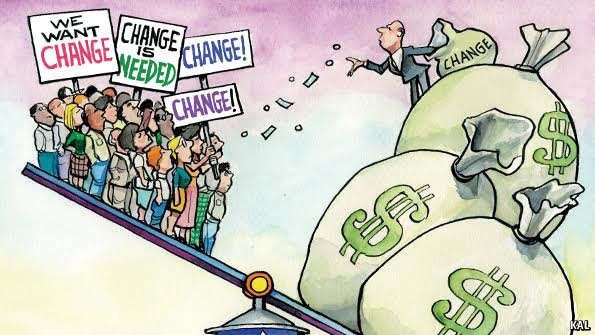
One could probably deduce that a large proportion of people today view income inequality as an issue that must be alleviated. Most even say that “the majority of Americans do not benefit as much as the top 1%” and that the economy is “not as beneficial for the lower class.” It just does not seem right that there are a small fraction of people that hold the majority of the world’s wealth in their hands, and mostly, seem to simply sit on their money. While some inequality is required to maintain an incentive to work hard and preserve a dynamic economy, more and more it is beginning to look as though people are becoming financially successful by familial means. From inheritances to sizable donations to universities swaying admission decisions, the old adage that anyone can make it and to simply “lift yourself from your bootstraps” is outdated and no longer feasible in today’s society. There are those who are born into situations where they simply are unable to rise out of their respective social status. To attempt to justify poverty because America’s “is not close to the severity of poverty worldwide” simply shows how much larger of an issue this really is. It seems as though this is such a large issue and is difficult to take into our own hands, which makes it all the more important to participate as a citizen to make a change on a large scale. If no change is to come, soon we will live in a world where any sort of success is achieved through family lineage, and not by “lifting yourself from your bootstraps.” I hope for a world where this will not be the case, and that we will realize that to move forward together, we must help others out of situations that cause them to be set back from the beginning.
 English 110 Honors Spring 2020