By Sydney Rubin and Katie Graboski
What is the first thing that comes to your mind when you hear the word health? When discussing between the two of us, we agreed that throughout our lives the focus of our teachers, family, and peers was physical well-being. Whether it was healthy eating habits, exercise, or learning how to take care of our bodies, mentors, both in the classroom and at home, stressed the importance of physical health. Looking back on our early education, we realized that mental health was never formally―or informally―taught as in-depth as physical health was. We wondered if other UD students had experienced the same phenomenon as we had.
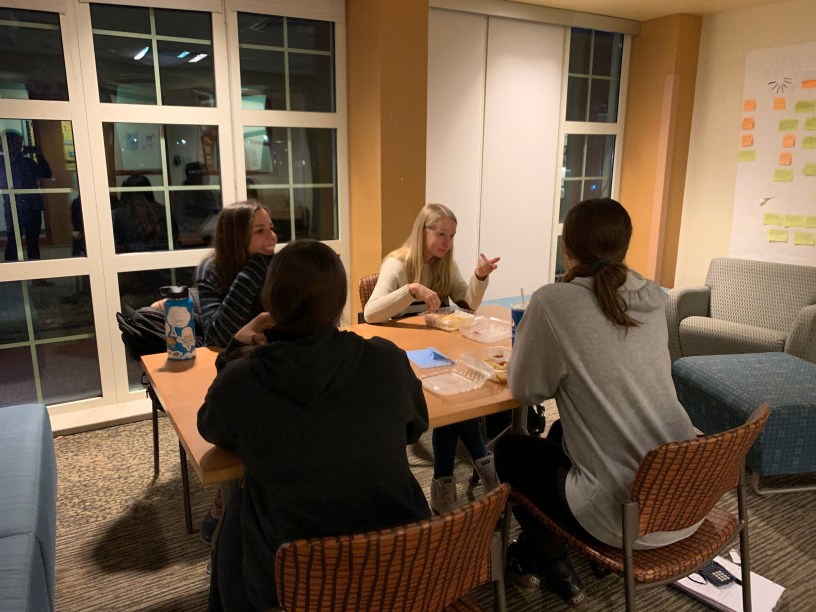
In order to determine whether our peers at UD had the same experiences that we did regarding education about health, we asked them multiple questions including: Have you been taught more about mental or physical health throughout your life? Were these topics emphasized more in the classroom setting at school, or by family members at home? Why do you think that is? We were not surprised to discover that everyone we spoke to had shared our experiences. The answer to the first question was unanimous. People overwhelmingly felt that physical well-being was held to a higher standard throughout their early childhood, especially during elementary school. They declared that as they grew older there was some attention placed on mental health and its importance, but nowhere near as much as physical health. The answers to our final question were slightly more varied but had the same theme. Most of the students that we interviewed agreed that mental health is simply a topic that people are not comfortable talking about in social settings.
To make sense of the manner in which the differences between discussions of mental and physical health occurred at home and during school, one student said, “At home, it was in the context of sports and having to maintain a healthy life with an athletic schedule. In school it was our health class, and gym class, trying to teach us how to have a balance too.” One student brought up the idea that “There isn’t a time of day devoted to mental health, but there is always time devoted to physical health during the day.” We have noticed this too. Throughout elementary, middle, and high school, entire classes have been devoted to physical health, but there has never been one designated solely to mental health. This is something that has to change. One student noticed this and said, “I feel that mental health has been neglected for far too long in our education system and a higher emphasis on it should definitely be taught in the future.”
The students that we interviewed at the University of Delaware have come to a clear consensus: mental health has not been prioritized enough during the early years of life. It is necessary for children to learn and understand at a young age that, yes it is important to take care of yourself physically, but it is even more important to be educated about mental well-being.
 English 110 Honors Spring 2020